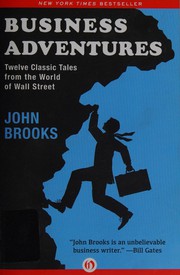
Founder connections
- Bill GatesRecommendation
“Business Adventures remains the best business book I’ve ever read.”
Gates named it his favourite business book in his July 13, 2014 review.Source - Patrick CollisonRated above average on his bookshelfCollison marks this title substantially above average on his historic bookshelf. The page lists owned books, only about half of which he says he read. An exact match to this catalog edition is not established.Source
- Warren BuffettRecommendation reported by Bill GatesGates says Buffett named it his favourite business book when asked in 1991, then lent him his copy.Source
Summary
John Brooks tells twelve stories about companies and financial markets under pressure. They include Ford's failed Edsel launch, Xerox's growth, corporate scandals, and the stock market crash of 1962. Each story follows the people involved and the events that shaped the result.
Brooks looks closely at how decisions happen inside a business: what leaders believe, what employees communicate, and how plans meet reality. His reporting gives space to conflicting motives and mistakes. The stories ask readers to examine how a company reached its position, including the choices that looked reasonable at the time.
Why read it Our view
The value for founders is in the detail behind each decision. Ford had research, money, and an established business behind the Edsel. Xerox committed years of work and funding to a technology whose commercial future was uncertain. Reading both stories lets you compare how companies judge demand, handle doubt, and commit resources.
These cases also help you examine your own reasoning. What evidence supports a plan? Which assumptions have become accepted facts inside the company? Would people bring you information that challenges the direction you have chosen?
Brooks gives enough context to make those questions useful. You can judge the choices with some sense of what people knew at the time, then compare their expectations with what followed.
Decisions from the book
Ford: launching a new car brand
- Decision: How to retain customers moving from Ford cars into more expensive models.
- Action: Ford approved a new medium-priced brand, the Edsel, after studies predicted growth in that market. It committed heavily before launch.
- Outcome: Ford expected at least 200,000 sales in the first year. It sold about 109,000 Edsels over two years before ending production. Brooks describes several contributing problems, including defects and changes in the market.
Xerox: continuing to fund an uncertain technology
- Decision: Whether Haloid, the company that became Xerox, should keep funding a copying technology through years of technical problems.
- Action: It retained the rights and spent about $75 million developing the technology between 1947 and 1960, using borrowing and share sales to help fund the work.
- Outcome: Its automatic office copier launched in 1959. Company sales grew from $33 million that year to more than $500 million in 1966.