- Ben Horowitz: "Andy Grove's Only the Paranoid Survive is a great book on strategy as is The Innovator's Dilemma by Clayton Christensen." source ↗
- Jensen Huang: "Clay Christensen I think has, the series is the best… I read a whole bunch of them and I read just about all of them" source ↗
- Mark Cuban: "No business should ever take what they have for granted" source ↗
- Steve Jobs: "It's important that we make this transformation, because of what Clayton Christensen calls 'the innovator's dilemma,' where people who invent something are usually the last ones to see past it, and we certainly don't want to be left behind." source ↗
- Brad Jacobs — Cited by David Senra on the Founders podcast as core to the disruption framework Jacobs applies in spotting industries ripe for consolidation source ↗
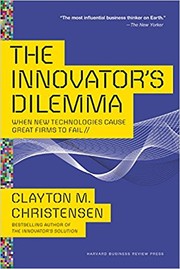
Published in 1997, The Innovator's Dilemma is Clayton Christensen's foundational study of why well-run, market-leading companies repeatedly lose to smaller entrants building cheaper, initially inferior products. Using the hard-disk-drive industry as his primary case study, Christensen distinguishes "sustaining" innovations, which established firms are good at, from "disruptive" innovations, which start by serving overlooked customers at the low end of a market before improving enough to take over the mainstream. The book argues that companies fail not from bad management but from good management — listening closely to existing customers and optimizing existing business models — applied to the wrong problem.
For a founder, this book is less a warning to incumbents than a playbook for attackers. Christensen's insight is that the best place to start is exactly where big companies won't bother looking: a small, low-margin, seemingly unattractive segment of the market that established players are happy to ignore or even abandon. That segment is a founder's opening, because incumbents' own resource-allocation processes and profit-seeking customers actively prevent them from chasing it, even when their own engineers see it coming.
David Senra has referenced Christensen's disruption framework repeatedly on Founders when discussing entrepreneurs who deliberately built from the bottom of a market up — describing it as a structural, almost physics-like explanation for why the underdog position is often the stronger one, not the weaker one. The practical lesson founders take from it: don't try to beat the incumbent at the thing the incumbent is already optimized for; find the un-served customer, win them completely, and only then move up-market where the profit and the competition both are. It also reframes "worse" products — slower, cheaper, less feature-complete — as a legitimate strategy rather than a shortcoming, as long as they are good enough for the customer being ignored by everyone else.