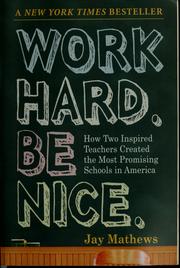
- Bill Gates: "Jay Mathews’ book Work Hard. Be Nice. describes the history of KIPP by telling the story of Mike Feinberg and Dave Levin. KIPP is remarkable in some ways, particularly in its ability to attract great teachers and engage and inspire students." source ↗
Washington Post education reporter Jay Mathews's 2009 account (Algonquin) of how two young Teach For America alumni, Mike Feinberg and Dave Levin, built KIPP from a single Houston classroom in 1994 into the largest charter-school network in the United States, on a formula of longer hours, high expectations, and the motto 'Work hard. Be nice.'
Read it as an org-building case study, not an education-policy book. Gates's note: "Jay Mathews' book Work Hard. Be Nice. describes the history of KIPP by telling the story of Mike Feinberg and Dave Levin. KIPP is remarkable in some ways, particularly in its ability to attract great teachers and engage and inspire students." His review itemizes the operating mechanics like a diligence report: 60 percent more contact time than normal schools (7:30 to 5, alternate Saturdays, three summer weeks), teachers reachable by students at any hour, fifth grade as the deliberate entry wedge, and Mathematica hired to run independent, hard-core measurement of alumni long after they leave.
The scaling story is the founder's story. Two gifted operators got "less gifted people doing most of what they do" — codifying craft so it survives replication — and grew from one classroom to 66 schools with a plan for 100 by 2011. The results Gates cites: while 20 percent of low-income students nationally attended college, the rate for former KIPP students was 80 percent. And the open questions he flags are the ones every scaling organization faces: costs, rules, and the ability to scale. The book answers the culture question and leaves the economics honestly unresolved.