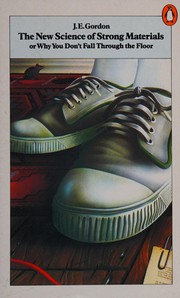
- Bill Gates: "Our ability to understand how materials behave has been central to the story of human progress over the years. One of the best ways to begin to understand this important subject is to read a book written more than 40 years ago." source ↗
J.E. Gordon's 1968 classic (revised 1976) on materials science for the non-specialist, written by a Royal Aircraft Establishment engineer who worked on wartime aircraft structures. Gordon explains why materials behave the way they do — why a sheet of paper tears easily along a fold, why glass is strong in compression but weak in tension, why wood is nature's best composite — through the physics of cracks, dislocations, and bonding. It remains in print decades later as the clearest introduction to structural engineering written for a general reader.
Gates wrote: "Our ability to understand how materials behave has been central to the story of human progress. One of the best ways to begin to understand this important subject is to read a book written more than 40 years ago." For a founder in hardware, construction, manufacturing, or any business built on physical stuff, Gordon provides the mental models for why things break and how to make them not break.
The book's core insight — that materials fail from crack propagation, not from inherent weakness — has applications well beyond engineering. Gordon shows that a crack is harmless until a stress concentrates at its tip; the same is true for organisational failures, code defects, and product weaknesses. Gordon's principle that 'the structure is as strong as its ability to redistribute load away from a local defect' is a lesson in resilience engineering that every founder should understand, whether they are building bridges, software, or teams.