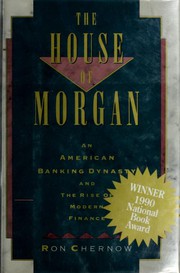
Ron Chernow's sweeping 1990 history of the Morgan banking dynasty, the book that established his reputation as the premier business historian of his generation. The House of Morgan traces the firm from Junius Spencer Morgan's London banking house in the mid-19th century through J. Pierpont Morgan's dominance of Gilded Age finance to the firm's evolution under his son Jack and its eventual transformation into a modern investment bank after the Glass-Steagall Act. Chernow captures Morgan's role in everything from financing U.S. Steel and rescuing the 1907 panic to shaping the Federal Reserve and financing the Allied war effort in both world wars. The book is as much a history of American finance as it is a family chronicle.
This is the single most important book about J.P. Morgan and the definitive account of how private banking built modern American capitalism. Chernow shows that Morgan was not a founder of a product or a company — he was a founder of a system. His firm served as a de facto central bank, an industrial-policy coordinator, and a gatekeeper for capital markets all at once. For founders, the essential insight is that Morgan's power was relational, not structural: he could do what he did not because of any legal authority but because of his reputation, his network, and his willingness to act when no one else would.
The book also contains a lesson in institutional decline. The House of Morgan was broken up and regulated into ordinariness across the 20th century — not by any single law but by a series of government responses to crises that Morgan himself had once managed privately. The Glass-Steagall Act, the Pecora hearings, and the Securities Act each peeled away a layer of the firm's power. The pattern — a founder builds private power, the public reacts, regulation reduces it — repeats across industries and eras.