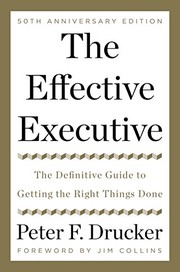
- Jeff Bezos — One of three books Bezos had Amazon's senior leadership read for the same 2013 book club source ↗
Peter Drucker's 1966 management classic on what makes a knowledge worker effective — not brilliant, not hardworking, but able to convert knowledge and decisions into action and results. Drucker's framework is built around five practices: managing time (knowing where it actually goes), focusing on contribution (asking what the organisation expects of you), making strengths productive (your own, your colleagues', your superiors'), concentrating on the few areas where superior performance will produce outstanding results, and making effective decisions (based on disagreement rather than consensus).
One of the three books Bezos assigned to Amazon's senior leadership for the 2013 all-day book club, alongside The Goal and The Innovator's Solution. The shelf entry records it as 'one of three books Bezos had Amazon's senior leadership read for the same 2013 book club,' with the framing that he used them 'as frameworks for sketching out the future of the company.'
For a founder, Drucker's most transferable chapter is the one on time. 'The effective executive,' Drucker writes, 'knows that time is the limiting factor. The output limits of any process are set by the scarcest resource.' That single sentence is the foundation of the Theory of Constraints (Goldratt was Drucker's student) and the same logic behind Bezos's two-pizza team rule and Musk's bottle-neck discipline. Drucker's insistence that decisions should be based on disagreement rather than consensus — because unanimity means nobody has thought hard enough — is visible in Amazon's culture of written memos dissected in silence before anyone speaks, and in Musk's rule that every requirement must carry a name and be questioned regardless of its source.