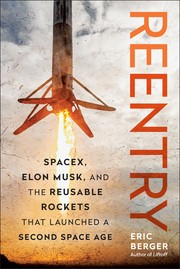
Eric Berger's 2024 sequel to Liftoff, covering the Falcon 9 years — booster recovery, Dragon, Starlink, and the transformation of SpaceX from a startup that barely reached orbit into the world's dominant launch provider. Berger traces the engineering culture that made reusable rocketry real: the ground-up redesigns, the landing barges named after Iain M. Banks's Culture ships, and the organisational discipline that kept a company launching at an unprecedented cadence while Starship was being built in the same facility.
Where Liftoff is about surviving near-death, Reentry is about turning a technical breakthrough into a sustainable operating machine. The shelf note calls the two books together 'the closest thing to a technical operating history of SpaceX,' and that is the founder angle: the second book documents the harder problem — not reaching orbit once, but doing it hundreds of times, recovering the booster, and building a satellite constellation that rewired global internet connectivity.
Musk's own five-step Algorithm — question the requirement, delete the part, simplify, accelerate, automate — is visible in every chapter: the Falcon 9 that lands on a droneship is a radically simpler architecture than the Falcon 1 that flew from Omelek. The lesson for a founder building through successive generations of a product is that the second version should look less like an upgrade and more like a different machine, because the constraint that defined v1 (reach orbit, any way possible) has been replaced by a new one (reach orbit reliably, at a fraction of the cost).