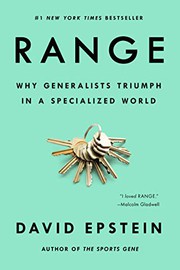
- Bill Gates: "Range explains the greatness of Roger Federer and other generalists" source ↗
David Epstein's 2019 book, published by Riverhead Books, argues that in most domains — innovation, complex problem-solving, entrepreneurship — generalists outperform specialists. Epstein, a former ProPublica reporter and author of The Sports Gene, builds his case from case studies: Roger Federer's late specialisation, the mathematician and polymath John von Neumann, the inventors who succeeded by working across fields, and research showing that the most-cited scientific papers are those that bridge disciplines. The book is a direct challenge to the '10,000 hours' rule of early specialisation.
"Range explains the greatness of Roger Federer and other generalists," Gates writes. The book is the research-backed case for the founder profile that the library's shelf is organised around: people who move across domains, who start late, who bring analogies from one field into another.
Epstein shows that in 'kind' learning environments (chess, golf, classical music), early specialisation and deliberate practice produce predictable excellence. In 'wicked' environments (innovation, startups, markets), broad experience and pattern-matching across domains outperform narrow depth. The founders on this library's shelf are almost all range players — Gates himself never finished college and built a company writing software for a machine he had not seen; Dyson was an art-school graduate who became an engineer; the pattern recurs across the collection. For a founder, the book is an argument against hiring only the specialist who has done exactly the job before; the person who has worked across three unrelated domains and is still learning will probably outperform the person with fifteen years of exactly the relevant experience, especially when the market shifts.