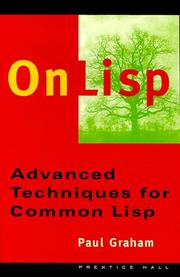
Paul Graham's advanced treatise on Lisp macros, closures, and the bottom-up programming style that distinguishes Lisp from every other language. The book demonstrates how to build embedded languages (domain-specific languages) inside Lisp by writing code that writes code — a technique Graham argues is the most powerful tool a programmer can have because it lets you solve problems at the right level of abstraction rather than the level your language forces on you.
Graham credits this book's thesis — bottom-up programming via macros and embedded languages — for Viaweb's speed advantage. In 'Beating the Averages' he explains that Lisp let them 'do things in a few lines of code that would have taken pages in whatever language our competitors were using,' and that the ability to define new languages for each subproblem made their three-person team as productive as a larger team using conventional tools.
For a founder, On Lisp is the fullest expression of Graham's philosophy of building: design your system so that the language grows to meet the problem, rather than contorting the problem to fit the language. This maps directly to how startups should build products — start minimal, let the design evolve, and invest disproportionately in the infrastructure that accelerates every subsequent feature. The book is a hard technical read but the principle it demonstrates is simple and immediately transferable: the most valuable code you write is the code that makes your other code easier to write.