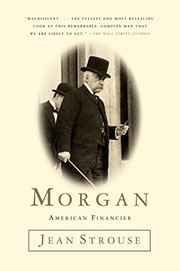
Jean Strouse's 1999 biography of J.P. Morgan, the first to draw on the long-restricted Morgan family papers and the only single-volume life that competes with Chernow's dynastic history as the definitive portrait of the man himself. Strouse focuses on Pierpont rather than his father or son, giving the fullest account of his business career, his art collection (which became the Morgan Library), his health, his temperament, and his complex relationships with the men he financed and the public that distrusted him. Her Morgan is a man of formidable intelligence and terrifying temper, a connoisseur who loved order and hated inefficiency, whose personal authority substituted for institutional power.
Where Chernow's House of Morgan is about the dynasty and the system, Strouse's Morgan is about the man — and the man is the more interesting subject. She shows that Morgan's business methods were inseparable from his personality: his insistence on personal relationships over contracts, his willingness to commit his own capital alongside clients', his contempt for anyone who did not keep their word, and his ability to sit at the center of a crisis and impose calm by sheer force of presence. These are not replicable management techniques — they are the expression of a specific temperament in a specific era.
For founders, the book's value is in showing how a founder can become an institution. Morgan did not build a company that could run without him; he became the company. That made him enormously effective in his lifetime and left his successors with an impossible act to follow. The question Strouse forces is not how to be like Morgan but whether a founder can build something that outlasts them without institutionalizing what made them effective — and whether institutionalizing it doesn't destroy it.