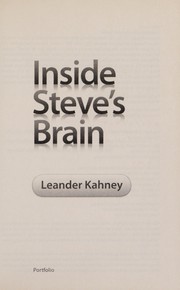
Leander Kahney, longtime editor of Cult of Mac and a journalist who covered Apple since the early 1990s, organises the material by trait rather than chronology — focus, design, control, elitism — and argues that the contradictions in Jobs's personality (the Zen Buddhist who screamed at subordinates; the control freak who could not control his impulses) are the method rather than noise. The central question Kahney asks is: how did the same man who threw tantrums also produce the most disciplined product line in technology? His answer is that Jobs's traits are a package deal — you could not have the taste without the tantrums, and anyone who wanted to work with him had to take the whole person. The book was updated after Jobs's death to include a chapter on his health crisis and Apple's future without him, and it remains one of the clearest portraits of how Jobs actually thought and operated.
The most valuable section of Kahney's book is his analysis of Jobs's focus method. When Jobs returned to Apple in 1997, the company had dozens of product lines — printers, scanners, Newton, multiple Mac models, even game consoles. Jobs killed seventy percent of them and drew a 2×2 grid: consumer/pro, desktop/portable. That grid became the product strategy for the next ten years. For founders, this is a concrete model: you cannot focus until you have drawn the boundary, and the boundary has to be brutally simple. The 2×2 grid is a tool, not a metaphor.
Kahney also dissects Jobs's control obsession in a way that is useful rather than sensational. Jobs required end-to-end control of the user experience because he believed that any seam — a third-party battery, a badly coded app, a clunky retail transaction — would break the illusion of magic. Founders in consumer products should ask themselves where their seams are, not whether they are 'control freaks' like Jobs. The question is structural, not temperamental.
The book's treatment of Jobs's reality distortion field is also worth the read. Kahney does not mythologise it as a superpower — he describes it as a tactic that worked on people who lacked conviction and failed on people who did not. The lesson is that the RDF only works when paired with a track record of being right, which Jobs had earned by 1997. A founder who tries to deploy an RDF without the track record is just lying.