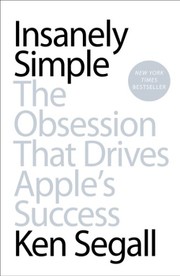
Ken Segall was the creative director at Apple's ad agency, TBWA/Chiat/Day, who worked directly with Steve Jobs from the NeXT years through the iMac and 'Think Different' campaigns. He is the person who proposed the name 'iMac' after Jobs's preferred name — 'MacMan' — drew blank stares from the team. This book treats simplicity not as a design aesthetic but as an operating discipline: small teams, brutal cuts, plain language, and a refusal to let complexity creep back in. Segall argues that Apple's simplicity obsession was the engine of its turnaround, and that most companies kill their own products by adding features, layers of approval, and internal complexity that the customer never sees. The book is structured around the tension between simplicity and its enemy, which Segall calls 'complexity' and personifies as committees, legal reviews, and the fear of being blamed for leaving something out.
The concept Segall labels 'insanely simple' is not about minimalism in design — it is about simplicity as a business strategy. His core argument is that complexity is a tax that compounds. One decision to add a feature, one extra approval step, one more page in the spec — each is individually harmless, but the accumulated load makes an organisation slow, expensive, and eventually immobile. For founders, the lesson is that the enemy is not competitors but the internal drift toward complication, and fighting it requires active, continuous effort, not a one-time simplification project.
Segall's most actionable insight is his description of how Jobs ran meetings: no more than a handful of people, no presentations longer than fifteen minutes, and a decision at the end. That last point is the one most teams miss — meetings that end without a decision are not meetings, they are updates, and updates can be emailed. Founders should benchmark their own meeting culture against Segall's description of a Jobs product review: someone demos, Jobs reacts, someone argues back, Jobs decides, the room moves on.
The book also contains the story of how the 'i' in iMac was chosen — Jobs rejected dozens of names before Segall proposed iMac, where 'i' stood for internet, individual, instruct, inform, and inspire. The moment captures Segall's method: find the simplest container for a complex idea and trust the audience to fill in the rest. Founders communicating their own vision should take the same approach rather than explaining everything.