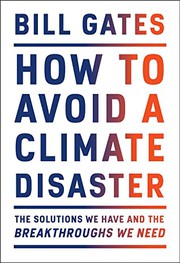
Bill Gates's 2021 book on climate change, published by Knopf, lays out a framework for getting to net-zero carbon emissions. He starts from a single number — 51 billion tonnes of CO2-equivalent per year — and works through every emitting sector (electricity, manufacturing, agriculture, transport, buildings) with the same decomposition: what is the current output, what technology exists to replace it, and what is the cost gap he calls the Green Premium. The book is the clearest published statement of how Gates reasons about a large, slow-moving problem.
This is a primary source on how Gates breaks an intractable problem into measurable pieces. The method is the product: he starts at 51 billion tonnes a year, decomposes it by sector (electricity 27%, manufacturing 31%, agriculture 19%, transport 16%, buildings 7%), assigns each a Green Premium (the cost difference between the dirty and clean solution), and then asks which gaps can be closed by policy, which by innovation, and which by volume. Every claim is quantified. Every solution carries a number.
For a founder, the book is worth reading not for its climate policy positions but as a specimen of problem decomposition at scale. Most technology pitches start with the solution. Gates starts with the size of the thing he is trying to move, refuses to handwave past any sector that is inconvenient to his thesis, and openly names the gaps he cannot see how to close. The Gates Foundation's 'about' entry on the same shelf calls it 'the clearest statement of how he reasons about a problem — decompose, quantify, then fund the gap markets will not close.' That frame — size the problem, name the gap, invest where markets won't — is portable to any market a founder is trying to create.