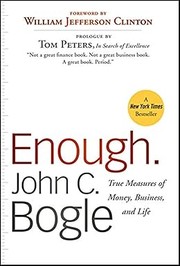
Enough is John Bogle's 2008 collection of reflections on values, purpose, and the excesses of the financial industry. Written in the wake of the 2008 financial crisis, it argues that the financial sector had abandoned stewardship for speculation, and that both individuals and institutions need to relearn what 'enough' means — enough return, enough wealth, enough complexity. The title comes from Kurt Vonnegut's phrase: 'I urge you to please notice when you are happy, and exclaim or murmur or think at some point, If this isn't nice, I don't know what is.'
This is the subject of Founders episode #58, and Senra uses it to explore the question that every growth-stage founder eventually faces: when is the pursuit of more — more returns, more AUM, more products — actually destroying what you built? Bogle argues that the financial industry lost its way not because of bad actors but because of a cultural shift from stewardship to speculation, and that the same dynamic can infect any company that stops asking what 'enough' looks like.
Senra's key framing is that Bogle's career was a single long argument against complexity and costs, and Enough is the moral capstone of that argument. For founders, the lesson is that the operating principles that got you to scale are not just tactics — they are ethical positions. Bogle refused to launch a hedge fund division because he believed hedge funds served managers, not investors. He refused to advertise because he believed the money should go to performance, not marketing. These were not business decisions; they were moral decisions with business consequences.
The book's chapter on 'The Spirit of Capitalism' — where Bogle distinguishes productive capitalism (investment, stewardship, long-term growth) from financial capitalism (speculation, intermediation, short-term extraction) — is Senra's most-cited passage. He connects it to modern debates about SaaS metrics, growth-at-all-costs, and the difference between building a business and assembling a financial asset.