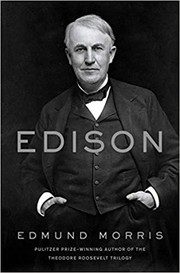
- Marc Andreessen: "on perhaps the greatest American builder of all, the builder who brought electricity to us all, Thomas Edison." source ↗
Edmund Morris's Edison (2019) is the first single-volume biography authorized by the Edison estate in decades, drawing on the full five-million-page archive at the Thomas Edison National Historical Park. Morris, the Pulitzer Prize-winning biographer of Theodore Roosevelt, traces Edison from his Midwestern boyhood through his career as America's most prolific inventor, covering the phonograph, the light bulb, the motion picture camera, and his later failed pursuits. The book presents Edison not as a solitary genius but as the head of a research laboratory that functioned as a proto-technology company.
Andreessen listed this among the companion books to his "It's Time to Build" essay, describing it as being "on perhaps the greatest American builder of all, the builder who brought electricity to us all, Thomas Edison." For a founder, the key insight Morris surfaces is that Edison's real invention was not any single device but the Menlo Park laboratory itself — the first industrial R&D facility organized as a company to produce inventions on schedule. Edison understood that systematic experimentation at scale would outperform the solitary inventor model, and he structured his organization accordingly.
Morris also shows Edison as a relentless self-promoter who understood narrative as a competitive weapon — he staged dramatic public demonstrations, courted journalists, and patented entire systems (the electric utility, not just the bulb). Founders who obsess over product while ignoring distribution, narrative, and systems thinking will find Edison's approach chastening. The book does not flinch from his failures, particularly his disastrous magnetic iron ore separation project, which nearly bankrupted him and taught a lesson in when to kill a losing bet — as valuable a founder skill as picking the winning ones.