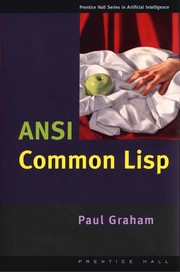
Paul Graham's introductory textbook on Common Lisp, covering the language as standardized in ANSI X3J13. Written while Graham was developing the ideas that became Viaweb — the first web-based application, built in Lisp — the book teaches functional programming, macros, object systems, and the bottom-up design philosophy that makes Lisp uniquely powerful for complex, evolving systems.
Graham's own bookshelf on his site lists this alongside On Lisp and Hackers & Painters as the three books he wrote. For a founder, the book is not just a language tutorial — it encodes Graham's philosophy of programming as a medium for building powerful systems with small teams. The Lisp he teaches is the same Lisp that let Viaweb, built by three people, compete against and beat well-funded competitors: 'We didn't have the resources to do everything the conventional way, so we had to find the most powerful tools.'
The lesson isn't to learn Lisp specifically — it's to choose tools that maximize your team's leverage, even if those tools are unfashionable. Graham's later essay 'Beating the Averages' makes this case explicitly: 'If you want to win, you need to use the most powerful tools you can find, and they won't always be the most popular ones.' The book is the technical foundation for that argument.