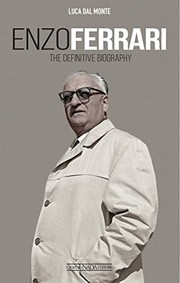
Enzo Ferrari: Power, Politics, and the Making of an Automotive Empire is Luca Dal Monte's exhaustive, nearly 1,000-page biography of Enzo Ferrari, drawing on extensive original research in Italy. It follows Ferrari from his birth in 1898 through his career as a driver, his years managing Alfa Romeo's racing team, the founding of his own company in the late 1940s, and his political maneuvering through Italy's Fascist era, Allied occupation, and postwar politics, up to his death in 1988 as head of a global brand.
David Senra covered this book on Founders (episode #98), using it as the deep, definitive text on Enzo Ferrari's rise — and the source for much of what he later distilled in his synthesis episode on Ferrari's obsession. The lesson Senra emphasizes most is that Ferrari succeeded first as a racing team operator and only reluctantly, out of financial necessity, as a car manufacturer: he sold road cars to fund his real passion, competing on the track, which reframes "the business" as something Ferrari treated as a means, not the end. Founders are meant to see how a company can be built on a founder's genuine, almost singular obsession, with commercial logic bent around it rather than the reverse.
Dal Monte's research into Ferrari's manipulation of drivers, rivals, and the press gives Senra material for one of his recurring points: that being an effective founder often requires being what he calls "an agitator of men" — someone willing to pit talented people against each other, withhold information, and use paranoia and pressure deliberately to extract performance, rather than trying to be liked. This is presented not as an endorsement but as an unsentimental account of how one of the most successful founders in automotive history actually operated internally.
The book's coverage of Ferrari's political survival — navigating Mussolini's Fascist government, then Allied occupiers, then Italy's postwar political landscape — is used by Senra to illustrate that founders operating in high-stakes, government-adjacent industries must be political operators as well as product people, and that Ferrari's ability to keep his company alive through radically different regimes was itself a founder skill, not a distraction from building cars.