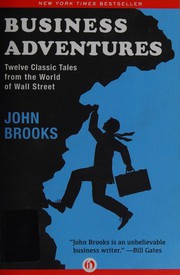
- Bill Gates: "Today, more than two decades after Warren lent it to me—and more than four decades after it was first published—Business Adventures remains the best business book I’ve ever read." source ↗
- Warren Buffett A 1969 collection of New Yorker pieces. The cited article records only that Gates read it on Buffett’s recommendation and said so in a July 2014 Wall Street Journal essay; the widely repeated detail that Buffett posted Gates his own copy is not stated there, and every account of it runs through gatesnotes, Fortune, the WSJ or CNBC, all of which 403 when fetched. A full-text search of all 48 shareholder letters confirms Buffett has never named the book in one, so the recommendation survives only at second hand. source ↗
Business Adventures is John Brooks's 1969 collection of twelve New Yorker essays on pivotal moments in American corporate history, including the Ford Edsel failure, the Xerox photocopier's rise, the GE price-fixing scandal, and the Piggly Wiggly short squeeze. Rather than offering financial formulas, it studies how ambition, hubris, communication failures, and organizational psychology shape whether a company thrives or implodes. Warren Buffett lent his personal copy to Bill Gates in 1991, and Gates has called it the best business book he's ever read.
Brooks isn't interested in balance sheets so much as in how people actually behave inside companies under pressure, and that is exactly why founders keep coming back to it: the technologies in the book are dated, but the human failure modes — a CEO who won't hear bad news, a launch rushed for internal politics rather than market readiness, a leak that snowballs because no one owned the response — are timeless. Each essay functions as a case study a founder can hold up against their own company today.
The Xerox and the Edsel chapters in particular are read as cautionary opposites: Xerox bet everything on a product nobody thought people wanted and won by understanding a real, underserved need better than the market did, while Ford's Edsel became a monument to designing-by-committee and mistaking internal enthusiasm for customer demand. Founders take from this that market research and internal conviction are not substitutes for each other, and that organizations often fool themselves long before the market has a chance to.
Because the book is structured as discrete, self-contained dramas rather than a single thesis, its real value to a founder is as a library of pattern-recognition — moments of corporate overreach, scandal, negotiation, and reinvention that train the instinct to spot the same dynamics forming inside their own company before they become a crisis.