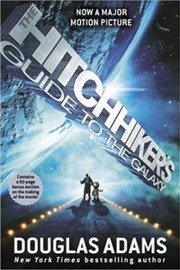
- Elon Musk: "Everyone has their sort of favorite philosopher, but my favorite philosopher is Douglas Adams." source ↗
- Richard Branson: "One of the titles in Richard Branson's own 'My Top 65 Books To Read In A Lifetime' list on Virgin.com." source ↗
Douglas Adams's 1979 comic science-fiction novel follows Arthur Dent, whisked off Earth moments before it is demolished for a hyperspace bypass, as he travels the galaxy with his friend Ford Prefect, the depressed robot Marvin, and the two-headed ex-President of the Galaxy Zaphod Beeblebrox. Along the way it delivers the running joke that a supercomputer spent 7.5 million years computing the answer to life, the universe, and everything, and returned '42' — a punchline about the absurdity of expecting a tidy answer to an unbounded question.
Hitchhiker's Guide is not a management text, and its value to founders is more temperamental than tactical: it is a sustained argument that the universe is indifferent, plans get destroyed for bureaucratic reasons that have nothing to do with merit, and the only sane response is curiosity, humor, and forward motion rather than despair. The book's most quoted advice — 'Don't Panic,' printed in large friendly letters on the cover of the in-universe guide — is invoked constantly outside the book as shorthand for staying level-headed when a company's own version of the Vogon constructor fleet shows up unannounced.
The novel's satire of bureaucracy — Arthur's house is demolished by a council that technically posted the planning notice somewhere unreachable, and Earth itself is destroyed the same way on a galactic scale — resonates with founders who spend real time fighting indifferent process rather than an intelligent competitor. The lesson many take from it is less a tactic than a stance: expect the system to be arbitrary, don't take arbitrary setbacks as evidence of your own failure, and keep moving.
Its other lasting artifact for builders is the fictional Guide itself: a crowdsourced, perpetually updated, wildly uneven reference work that beats the stodgy Encyclopaedia Galactica mostly by being cheaper, funnier, and more current — an early comic prefiguring of user-generated and continuously updated information products, decades before Wikipedia.