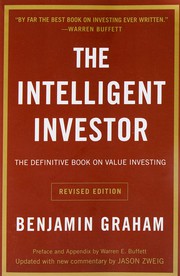
- John Bogle: "First published in 1949, Benjamin Graham's classic text is perhaps the best book ever written about investing. With his clear and accessible writing, Graham laid the foundation for all investment books that followed." source ↗
- Warren Buffett: "Of all the investments I ever made, buying Ben’s book was the best (except for my purchase of two marriage licenses)." source ↗
Benjamin Graham's The Intelligent Investor, first published in 1949 and revised through several editions, lays out the foundational principles of value investing: buying securities for less than their intrinsic worth, demanding a margin of safety, and treating the stock market's daily price swings ('Mr. Market') as an opportunity to exploit rather than a signal to follow. The book distinguishes the 'defensive' investor, who wants a simple, low-effort portfolio, from the 'enterprising' investor willing to do the analytical work to find mispriced opportunities, and is famous as the book that shaped a young Warren Buffett's entire investment philosophy.
David Senra treats The Intelligent Investor as one of the foundational texts of the Founders podcast canon because Graham's central idea — a margin of safety — generalizes far beyond stock picking. For a founder, the equivalent is building enough slack into the business (cash reserves, conservative burn, realistic projections) that being wrong about the future doesn't sink the company. Graham's insistence on buying assets for meaningfully less than their demonstrable worth translates directly into a founder's discipline around costs, hiring, and commitments: never bet the company on optimistic assumptions holding true.
Graham's 'Mr. Market' allegory — an emotional business partner who shows up every day offering to buy or sell at wildly different prices depending on his mood — is a mental model Senra repeatedly applies to founders' own psychology, not just the stock market. The lesson is to treat other people's panic or euphoria (about your company, your market, or your competitors) as information to act on selectively, never as a signal you're obligated to follow. Buffett has said reading this book at nineteen changed the trajectory of his life, and founders are meant to take the same lesson: build a personal framework for rational decision-making that doesn't bend to prevailing sentiment.
The book also draws Graham's sharp distinction between investing and speculating — a distinction founders can apply to their own capital allocation decisions, favoring moves with an analyzable, favorable expectancy over exciting but unquantifiable bets.