- Bill Gates: "Good ideas" source ↗
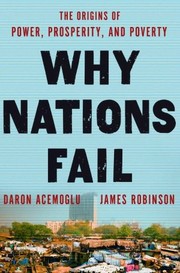
Daron Acemoglu and James A. Robinson's 2012 book (Crown) arguing that nations prosper or fail because of their institutions: 'inclusive' systems that spread power and opportunity generate growth, while 'extractive' ones that concentrate them strangle it. The case runs from Nogales to Venice to South Korea; Acemoglu and Robinson shared the 2024 Nobel Prize in Economics with Simon Johnson.
This is the rare book Gates reviewed negatively, and his dissent is the reason to read it. "Normally, I'm fairly positive about the books I review, but here's one I really took issue with," he opens, before calling the analysis vague and simplistic. His counterattacks are concrete: Venice declined because "competition came along," not because its institutions turned extractive; the Asian miracles of Hong Kong, Korea, Taiwan, and Singapore grew under decidedly non-inclusive politics; and China's six-hundred-year run of innovation from 800 to 1400 had everything to do with geography and competition between empires. His alternative theory: growth tracks the embrace of capitalist economics — private property, markets, infrastructure, education — independent of the political system.
For a founder the book works on two levels. The inclusive/extractive frame is a genuinely useful lens for platforms and org design: does your company spread upside and information, or concentrate them? And Gates's demolition is a template for stress-testing any grand theory — check it against the cases where it should fail. A framework that explains everything usually explains nothing; this shelf keeps both the theory and its best rebuttal.