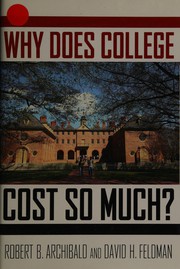
- Bill Gates: "This book looks at college costs in the context of the larger economy, and offers suggestions for policy to increase access." source ↗
Robert B. Archibald and David H. Feldman, two William & Mary economists, argue in this 2010 book (Oxford University Press) that rising tuition is driven less by waste, prestige games, or administrative bloat than by economy-wide forces: college is a personal service dependent on highly educated labor, and Baumol's cost disease makes such services relatively more expensive as the rest of the economy grows more productive.
Gates's note is brief but points at the right thing: "This book looks at college costs in the context of the larger economy, and offers suggestions for policy to increase access." The mechanism the authors build is the transferable concept. In labor-intensive services — teaching, medicine, live performance — productivity grows slowly because the labor is the product, so as wages across the economy rise with manufacturing productivity, the relative price of those services climbs year after year. The authors' blunt conclusion: the main culprit is economic growth itself, and the proof is that college cost trajectories track other personal-service industries rather than diverging from them.
Any founder selling skilled human time lives inside this mechanism. Services margins compress unless you change the production function, and your customers will blame greed or bloat for what is actually arithmetic — the book arms you with the counter-explanation and the data. It also models a useful intellectual posture: taking an unpopular position (the academy is not the villain) and defending it with industry comparisons rather than rhetoric.