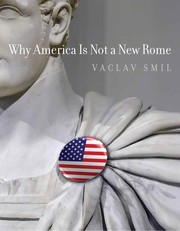
- Bill Gates: "Vaclav Smil has written another very informative book called Why America is Not a New Rome." source ↗
Vaclav Smil's 2010 book (MIT Press) testing the then-popular analogy between a declining United States and the Roman Empire, and finding it empty. Comparing the two on population, energy, military reach, and innovation, Smil concludes that 1,500 years of change have stripped the comparison of any predictive power.
Gates's note is typically spare: "Vaclav Smil has written another very informative book called Why America is Not a New Rome." The value for a founder is watching Smil kill a seductive analogy with quantities. Rome at its peak held 12 percent of the world's population; the United States at the millennium had 4 percent. Roman life expectancy ran 20 to 30 years, and human and animal muscle supplied virtually all kinetic energy; the United States produced 22.5 percent of world GDP in 2005 with China and others gaining. On those numbers the comparison fails before the narrative begins.
Smil's positive findings are sharper than his negative one. The real similarity is that outsiders overestimate the dominance of both powers, and the United States is not an empire by any reasonable definition — at most a hegemon. He also notes that Rome's record in science and engineering was "unremarkable," while Han-dynasty China, its contemporary, gave the world paper, iron, ploughs, and nautical advances. The Smil method — quantify both sides of any historical analogy before letting it drive strategy — applies directly every time someone tells you this is 1999 again, or that you are building the next Yahoo.