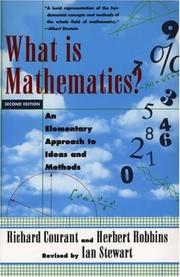
- Paul Graham: "Other highly recommended books: What is Mathematics?, by Courant and Robbins; Geometry and the Imagination by Hilbert and Cohn-Vossen. And for those interested in graphic design, Byrne's Euclid." source ↗
Richard Courant and Herbert Robbins' 1941 survey of elementary mathematics — number theory, geometry, calculus, topology, and analysis — designed to show a general reader what mathematicians actually do and why it matters. The book assumes only high school math and builds up to real mathematical thinking: proofs, counterexamples, infinities, and the aesthetic standards that distinguish elegant solutions from merely correct ones. Courant, a student of Hilbert at Göttingen, wrote it to counter the widespread belief that mathematics is nothing more than calculation.
Graham recommends it in 'Undergraduation' as one of the books that shows 'what math is really about' — not memorized formulas but a way of thinking. He places it alongside Geometry and the Imagination and Byrne's Euclid as the books he wishes he had studied more of in college. The recommendation comes in an essay where Graham argues that math is 'a valuable source of metaphors for almost any kind of work' and that learning what math really is matters more than the specific techniques.
For a founder, the book's value is in its approach: it teaches you to think structurally, to prove things rather than assume them, and to recognize elegant solutions. Courant's insistence that mathematical thinking is about asking the right questions, not applying the right formulas, maps directly to startup strategy. The book also demonstrates that deep knowledge of first principles makes complex problems tractable — a lesson that applies to product design, market analysis, and organizational design equally. Graham's recommendation signals that this is the math book for people who don't think they like math.