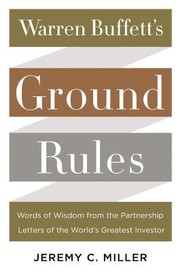
- Warren Buffett: "Finally, Jeremy Miller has written Warren Buffett's Ground Rules, a book that will debut at the annual meeting. Mr. Miller has done a superb job of researching and dissecting the operation of Buffett Partnership Ltd. and of explaining how Berkshire's culture has evolved from its BPL origin." source ↗
Jeremy Miller, a former hedge fund analyst, reconstructs and annotates the monthly letters Warren Buffett wrote to his Buffett Partnership Ltd. partners from 1956 to 1969 — the pre-Berkshire years when Buffett ran a small investment partnership. The letters contain Buffett's earliest articulations of his ground rules: the partnership agreement's terms, his expectations for returns versus the Dow, his insistence on measuring performance over multi-year periods, and his unvarnished postmortems on mistakes. Miller's commentary contextualizes them for modern readers.
Buffett recommended this book at the 2015 annual meeting: 'Jeremy Miller has written Warren Buffett's Ground Rules, a book that will debut at the annual meeting. Mr. Miller has done a superb job of researching and dissecting the operation of Buffett Partnership Ltd. and of explaining how Berkshire's culture has evolved from its BPL origin.' For founders, these partnership letters are the closest surviving record of Buffett's investment mind before Berkshire — a period when he operated at a smaller scale with fewer resources but clearer rules. The ground rules themselves — how the partnership's gains and losses were shared, how Buffett was compensated, how annual performance was measured, and the explicit understanding that partners could not withdraw capital on short notice — are a template for any founder who wants to set clear expectations with their own investors from day one.
The deeper lesson is that Buffett's later success at Berkshire was not a departure from his partnership discipline but a direct continuation of it. The rules he set as a 25-year-old running $100,000 in Omaha are the same principles he applied at Berkshire: partnership attitude, long-term measurement, absolute candor about mistakes, and an insistance on terms that let him invest without being forced to sell at the wrong time.