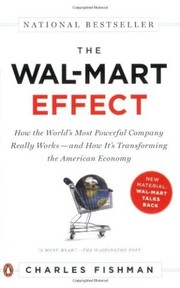
Charles Fishman's 2006 investigation of what Walmart became after Sam Walton's death — not a biography of the founder but a study of the institution his rules produced. Published well after Walton's 1992 death, the book traces Walmart's effect on suppliers (who are squeezed to the point of redesigning their entire businesses), workers (whose wages and benefits set the floor for retail employment nationwide), and local economies (where a Walmart opening reshapes the competitive landscape for miles). It is the standard reference for understanding the second-order consequences of Walton's system once the founder was no longer there to adjust it.
For founders, The Wal-Mart Effect is the most important book about Walmart that is not about Sam Walton. It answers the question: what happens to the system you built after you're gone? Walton's operating principles — low prices, high volume, relentless cost discipline — continued to operate after his death, but without the founder's personal judgment to moderate them, they became systemic forces with consequences he might not have intended or anticipated. The book is a reminder that a founder's incentives outlive the founder, and that designing a company whose defaults are good even when no one is steering is one of the most durable things a founder can do. It is also a case study in the law of unintended consequences applied to business models: every efficiency gain for Walmart was someone else's cost increase, and that asymmetry is not always sustainable.