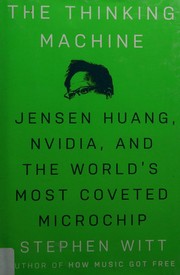
Stephen Witt's biography of Jensen Huang and Nvidia, named FT Business Book of the Year 2025 and Best Book of 2025 by The Economist. Witt traces Nvidia's arc from its founding at a Denny's in East San Jose in 1993 through near-bankruptcy in the late 1990s, the invention of the GPU, the bet on CUDA that turned graphics chips into general-purpose parallel processors, and the AI boom that made Nvidia the first company to exceed a $5 trillion market cap. It is the more narrative and accessible of the two major Huang biographies (alongside Tae Kim's The Nvidia Way), covering the engineering, the business decisions, and the singular management culture of its founder-CEO.
Where Tae Kim's The Nvidia Way is the company-building manual, Witt's The Thinking Machine is the narrative history — stronger on the dramatic arc, the near-death experiences, and the improbable rise. For founders, the central case study is Nvidia's near-bankruptcy in 1997, when the company was down to about one month of payroll and the RIVA 128 chip saved it. That experience seeded every decision that followed: the refusal to be complacent, the obsession with eliminating latency and moving at 'speed of light,' the flat organization with 60 direct reports reporting to Huang, and the conviction that 'strategy is action' — not a plan you write but the decisions you actually make. Huang's line that Nvidia was 'tortured into greatness' is the thread that runs through the entire story, and this book tells that story with more narrative momentum than any other account.