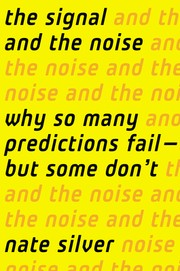
- Bill Gates: "Silver knows a lot about baseball, and I especially liked his explanation of hold’em poker." source ↗
Nate Silver's 2012 book (The Penguin Press) on why predictions fail — across elections, baseball, weather, earthquakes, poker, and financial markets — arguing for probabilistic, Bayesian forecasting over confident point estimates. It was published just before his FiveThirtyEight model called all fifty states in the 2012 presidential election.
Gates read it the year after Silver's election fame and his shelf note is telling about how: "Silver knows a lot about baseball, and I especially liked his explanation of hold'em poker." The domains he praised are the ones with dense feedback loops, which is the book's core sorting mechanism: weather forecasts improve because they are made and scored daily, while earthquake prediction stagnates because there is nothing to calibrate against. A founder should ask which of their own forecasts live in a feedback-rich domain before trusting them.
The working methods transfer directly: treat every forecast as a probability to be updated, not a verdict to be defended; prefer the fox's many small models over the hedgehog's one big theory (the book runs on Philip Tetlock's research); and distrust any model that fits the past beautifully — overfitting is what a plausible story about old data looks like. Silver's poker chapters make the economic point concrete: in a weak field you only need to be a little better than everyone else, and the money leaves when the suckers do.