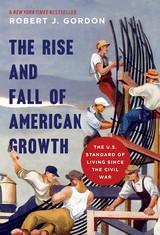
- Bill Gates: "The book was a fantastic read, and well worth the time" source ↗
Robert J. Gordon's 2016 economic history (Princeton University Press, 743 pages) argues that the century from 1870 to 1970 was a one-time transformation of American life — electricity, indoor plumbing, the automobile, antibiotics — whose growth the digital revolution after 1970 cannot match. The final chapters predict continued slowdown under headwinds of inequality, education, demographics, and debt.
Gates's review is a model of how to read a book you half-disagree with. "The book was a fantastic read, and well worth the time," he writes — and then separates the halves. The "rise" he calls eye-opening: the statistic he singles out is adoption speed, from 2.3 motor vehicle registrations per 100 households in 1910 to 89 by 1930, proof that diffusion, not invention, is what changes living standards. The "fall" he rejects outright: Gordon treats the digital revolution as confined to "communication, information, and entertainment," and Gates counters that it changes "the very mechanism of the marketplace."
Two transferable tools come out of the argument. First, measurement: Gates's sharpest point is that Total Factor Productivity and GDP were built to value tractors and refrigerators and systematically miss free goods like Wikipedia — a founder building anything cheap or free should know the scoreboard is miscalibrated in their favor. Second, Gordon's refrain that the great inventions "could happen only once" cuts both ways, as Gates notes: a cure for Alzheimer's also happens only once. Satya Nadella recommends the book too. Reading the strongest version of the pessimist case is how you find out whether your optimism is analysis or temperament.