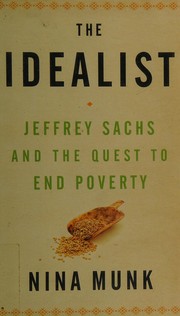
- Bill Gates: "A cautionary tale from Africa." source ↗
Nina Munk's 2013 narrative of Jeffrey Sachs's Millennium Villages Project, the UN-backed attempt to end extreme poverty in rural Africa by delivering a bundled intervention (agriculture, health, education, infrastructure) to entire villages at once. Munk embedded with the project in western Kenya and followed it for years. Her account shows a grand plan — one of the most ambitious development experiments ever attempted — meeting the reality of local politics, soil chemistry, rainfall, and the gap between what a map promises and what a village delivers.
Gates called it "a cautionary tale from Africa." For a founder, this is the canonical case study in the difference between a plan that looks beautiful on paper and a plan that works in the field. Sachs, a world-renowned economist, designed a complete system — $120 per person per year buys the entire package — and raised tens of millions to execute it. The villages got better in some measures and not in others, and the question Munk leaves the reader with is whether the project's achievements were durable or would collapse when the external funding stopped.
The founder lesson is about the epistemology of success in complex systems: how do you know your intervention caused an outcome when the outcome has ten other causes? Sachs assumed that sufficiently large inputs would produce predictable outputs. What he discovered — and what every founder of a mission-driven organisation discovers — is that the system pushes back. Munk's reporting is not an argument against ambition; it is an argument for building feedback loops that tell you, early and honestly, whether your theory of change is wrong.