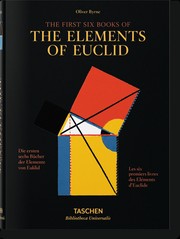
- Paul Graham: "Other highly recommended books: What is Mathematics?, by Courant and Robbins; Geometry and the Imagination by Hilbert and Cohn-Vossen. And for those interested in graphic design, Byrne's Euclid." source ↗
Oliver Byrne's 1847 edition of Euclid's Elements, which replaced the traditional Greek text with color-coded diagrams — red, yellow, and blue geometric figures that make the proofs visually self-evident without any words. Byrne's innovation was to treat geometry as a visual language, not a verbal one: each proof is a composition of colored shapes that anyone, regardless of language or mathematical training, can follow. The Taschen facsimile edition has become a cult object for its beauty as a printed book and its radical pedagogical insight.
Graham recommends Byrne's Euclid in 'Undergraduation' specifically 'for those interested in graphic design.' But the recommendation carries a deeper point: Byrne's method — making the structure of a proof visible through color and shape rather than text — is a case study in what it means to reframe a problem so that the solution becomes obvious. Euclid had been taught with words for two thousand years; Byrne saw that the words were getting in the way.
For a founder, the book is a demonstration that the way you present information determines how easily it can be understood. Byrne's insight is not a mathematical one — it's a communication insight. Every founder builds interfaces — products, pitches, memos, org charts — and Byrne's principle applies to all of them: find the visual structure that makes the logic self-evident, and you eliminate the need for explanation. The book also embodies Graham's principle that 'beauty is the first test': a book that makes geometry beautiful is a book that makes geometry understandable.