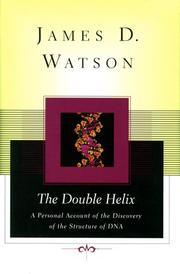
- Paul Graham: "The most vivid example of fierce nerds in action may be James Watson's The Double Helix. The first sentence of the book is 'I have never seen Francis Crick in a modest mood.'" source ↗
James Watson's personal account of the discovery of the structure of DNA, published in 1968 to enormous controversy for its unflattering portraits of the scientists involved — including Watson himself. The book opens with 'I have never seen Francis Crick in a modest mood' and proceeds to document the race against Linus Pauling and Rosalind Franklin with a competitiveness, impatience, and unfiltered honesty that was unprecedented in scientific memoir. Watson and Crick's breakthrough in 1953 depended on their willingness to work on problems they only half understood, to build incorrect models, and to treat scientific competition as a personal contest.
Graham uses The Double Helix as his primary exhibit of fierce nerds in action. In his essay 'Fierce Nerds,' he writes: 'The most vivid example of fierce nerds in action may be James Watson's The Double Helix. The first sentence of the book is “I have never seen Francis Crick in a modest mood,” and the portrait he goes on to paint of Crick is the quintessential fierce nerd: brilliant, socially awkward, competitive, independent-minded, overconfident. But so is the implicit portrait he paints of himself.' Graham argues that Crick and Watson's 'fierce nerdiness was integral to their success — their independent-mindedness caused them to consider approaches most others ignored, their overconfidence allowed them to work on problems they only half understood, and their impatience and competitiveness got them to the answer ahead of two other groups.'
For a founder, the book is a proof that the personality traits that make someone difficult in polite company — impatience, competitiveness, social awkwardness, overconfidence — are exactly the traits that win in a race where the only thing that matters is getting the right answer first. Watson's willingness to build and discard wrong models at high speed is a research methodology that maps directly to the startup method of rapid iteration: the group that builds the most models, even wrong ones, wins.