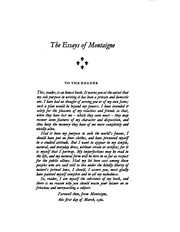
- Paul Graham In ‘The Age of the Essay’ Graham traces the genre to Montaigne’s 1580 essais — French for ‘attempts’ — and builds his own theory of writing as exploration on it. source ↗
Michel de Montaigne's 1580 essais — French for 'attempts' — invented the personal essay as a literary form. Writing in the isolation of his château tower during the French Wars of Religion, Montaigne turned his own mind into an object of study, examining friendship, education, death, cannibals, books, and the unreliability of human judgment with a frank, skeptical, conversational voice that had no precedent. The essays are not arguments with conclusions but explorations — he follows a thought wherever it leads, corrects himself, contradicts himself, and insists that the reader think alongside him rather than accept prepackaged wisdom.
Graham traces his own theory of writing directly to Montaigne. In 'The Age of the Essay,' he writes that the essay 'is named after the French word essai, meaning an attempt. An essay is something you write to try to figure something out.' Graham credits Montaigne with inventing not just a form but a method — writing not to express what you already know, but to discover what you think. This is Graham's own practice: his essays, which generated the ideas that became Y Combinator's philosophy, were written to explore questions he couldn't answer, not to broadcast answers he already had.
For a founder, Montaigne offers a model of intellectual honesty that is rare in business. His willingness to be wrong, to change his mind, and to examine his own motives without self-deception is the same quality Graham calls 'earnestness' — the single most important trait he looks for in founders. The essays also teach a practical skill: thinking by writing. Graham's method of writing essays to clarify his own thinking about startups and technology is directly borrowed from Montaigne, and any founder who wants to think more clearly can adopt the same practice.