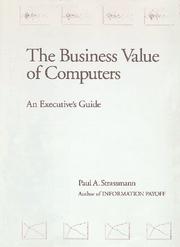
- Steve Jobs: "He wrote a book, though, before he got this job called The Business Value of Computers. It's rather thick, and it's not good bedtime reading. But you can plow through it, and there's some incredible stuff in it." source ↗
Paul Strassmann, the Pentagon's CIO, examines whether corporate IT spending actually produces returns. His key finding — based on surveying companies from unsuccessful to highly successful — is that the amount spent on information technology as a percentage of revenue is nearly identical across all performance levels, but that successful companies spend the majority on operational productivity applications while unsuccessful ones spend on management productivity.
Jobs recommended Strassmann's book during his 1992 MIT Sloan Distinguished Speaker Series lecture. He told the audience: 'He wrote a book, though, before he got this job called The Business Value of Computers. It's rather thick, and it's not good bedtime reading. But you can plow through it, and there's some incredible stuff in it.' Jobs used Strassmann's framework to explain why NeXTSTEP targeted operational productivity — custom applications for trading, healthcare, manufacturing — rather than the management-productivity market that PCs and Macs already dominated.
The core insight for founders is Strassmann's counter-intuitive finding: spending more on IT does not correlate with better performance. What matters is where the money goes. Management productivity tools (spreadsheets, email, office suites) make individuals incrementally more efficient; operational productivity tools (custom apps that automate core business processes) change how the business itself works. Strassmann gave Jobs a language for arguing that the PC revolution had barely touched the real problems of enterprise — a gap NeXT was designed to fill.