- Peter Thiel: "The weirdest idea anyone ever had about the future is that we should expect it to look like the past — but that's what the reigning science of statistics assumes. Nassim Taleb has not been fooled; he is the single best guide to understanding uncertainty." source ↗
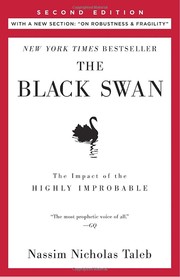
The Black Swan is Nassim Nicholas Taleb's 2007 investigation of highly improbable, high-impact events that are predictable only in retrospect. Taleb argues that human cognition is structurally biased to ignore these events — we build narratives around what we understand, which excludes the very things that shape history most. The book is a philosophical attack on the pretense of prediction and a defense of robustness against uncertainty. It is one of the most influential non-fiction books of the 21st century.
Thiel explicitly recommended The Black Swan as one of his six favorite books, calling Taleb 'the single best guide to understanding uncertainty.' The connection between Thiel and Taleb is intellectual: both argue that the most important events are the ones standard models cannot predict, and both reject the 'bell curve' view of the world in favor of a 'fat-tailed' distribution where outliers dominate.
Senra connects Taleb's black-swan framework directly to startup dynamics: most of the value in venture capital comes from a tiny fraction of investments, and the companies that produce those returns are the ones that could not have been predicted in advance. For founders, Taleb's message is that the biggest risks and opportunities are the ones you cannot see, and that the correct response is not better prediction but better antifragility — build a company that benefits from volatility rather than trying to avoid it.
The book's critique of expert prediction is also a direct challenge to the business planning industry. Taleb argues that the track record of economists, political forecasters, and stock pickers is worse than random, and that the arrogance of prediction is a danger to those who rely on it. Thiel's own 'secrets' framework (Zero to One) — important truths that few people believe — is a practical application of Taleb's insight that the most valuable knowledge is the kind that standard models miss.