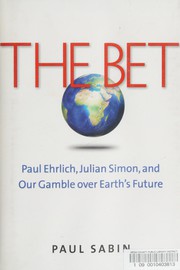
- Bill Gates: "I recommend The Bet to anyone wanting to understand the history of the divisive discussions we have today, especially the stalemate over climate change" source ↗
Paul Sabin's 2013 book about the most famous wager in environmental history: in 1980, biologist Paul Ehrlich bet economist Julian Simon that the prices of five metals (chromium, copper, nickel, tin, tungsten) would rise over a decade, proving that resource scarcity would drive up costs. Simon bet they would fall, proving that human ingenuity would outrun depletion. Ehrlich lost every one. Sabin uses the bet as a lens on the larger argument between those who see planetary limits and those who trust innovation to overcome them.
Gates wrote: "I recommend The Bet to anyone wanting to understand the history of the divisive discussions we have today, especially the stalemate over climate change." For a founder, the Ehrlich–Simon wager is the canonical case study in a question that every technology company implicitly bets on: is human problem-solving capacity bounded or unbounded?
The bet's structure is instructive. Ehrlich and Simon argued from the same data, neither changed the other's mind, and the outcome was decided by a market test — actual commodity prices — that both sides had accepted in advance. Sabin shows that the real lesson is not that Simon was right and Ehrlich wrong, but that the debate itself is irresolvable on its own terms because the two sides hold incompatible priors about substitution, price signals, and the time horizon over which scarcity binds. A founder who understands this asymmetry can see why certain arguments — climate, energy, regulation — never settle: they are framed in systems that cannot falsify each other's premises.