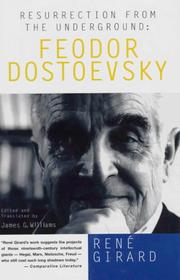
- Peter Thiel: "There is no better way to think about human irrationality than to read Dostoevsky, and there is no better reader of Dostoevsky than Mr. Girard." source ↗
Resurrection from the Underground is René Girard's 2015 study of Feodor Dostoevsky, reading his major novels — Notes from Underground, Crime and Punishment, The Idiot, Demons, The Brothers Karamazov — through the lens of Girard's mimetic theory. Girard argues that Dostoevsky's characters are driven by mimetic desire (wanting what others want) and that their psychological crises are expressions of the breakdown of mimetic structures. The book is both a literary analysis and a restatement of Girard's anthropology of desire.
Thiel recommended this book and called it the best guide to human irrationality: 'There is no better way to think about human irrationality than to read Dostoevsky, and there is no better reader of Dostoevsky than Mr. Girard.' The connection to Thiel's venture philosophy is direct: Thiel has repeatedly credited Girard's mimetic theory as the framework that explains why most people pursue the same opportunities (following mimetic desire) while the best opportunities lie in what everyone is ignoring.
Senra draws on Girard to explain the startup pattern of competitive escalation — founders chase what other founders are chasing, VCs invest in what other VCs are investing in, and the crowd converges on the same set of 'obvious' opportunities while the genuinely valuable ones remain invisible. The concept of mimetic desire is central to Thiel's contrarian thesis: a monopoly is built by going where no one else is going, which requires rejecting the mimetic pull of the crowd.
For founders, Resurrection from the Underground is the most accessible entry point into Girard's thought that Thiel has explicitly endorsed. The book shows that the pattern of self-destructive behavior driven by wanting what others want is not a modern problem but a universal human pattern, documented in literature as in life. Founders who have internalized mimetic theory tend to ask a different question: not 'what is everyone building?' but 'what would I build if no one were watching?'