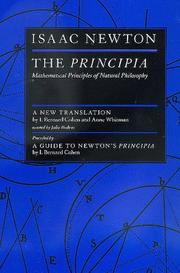
- Thomas Edison: "had even attempted to struggle through Newton's Principia, whose mathematics were decidedly beyond both teacher and student" source ↗
Isaac Newton's 1687 Principia, written in Latin, is the foundational text of classical physics. It states the laws of motion and universal gravitation, defines mass, force, and acceleration, and uses mathematical reasoning to explain the orbits of planets, the tides, and the behaviour of projectiles. The Principia is one of the most influential works in the history of science, establishing the mechanistic worldview that dominated physics for two centuries.
Thomas Edison attempted to read the Principia as a boy with his mother, before he had the mathematics to understand it. The source (Dyer & Martin's authorized biography, quoted in the Munro account) records that he 'had even attempted to struggle through Newton's Principia, whose mathematics were decidedly beyond both teacher and student.' For founders, the lesson is not in the physics but in the ambition: Edison, a child who had left school at 12, chose to struggle with the hardest science book he could find rather than read at his level. That intellectual ambition — the instinct to reach for the original source, not the simplified summary, even when it is beyond your current ability — is a habit that founders can cultivate directly.
Newton's first-principles approach — deriving the behavior of the universe from a small set of fundamental laws — is also a mental model for founders building a business: understand the foundational principles of your industry deeply enough that you can reason from them, rather than copying what competitors do and hoping it works.