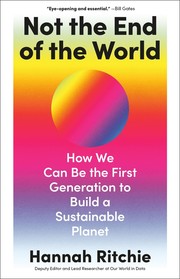
- Bill Gates: "His life and work have influenced my own tremendously—and just a few pages into Ritchie's essential and hopeful new book, Not the End of the World: How We Can Be the First Generation to Build a Sustainable Planet, it became clear that she was carrying on his tremendous legacy." source ↗
Hannah Ritchie's 2024 book, published by Little, Brown Spark, argues through data that the world is making measurable progress on environmental problems — air pollution, deforestation, biodiversity loss, plastic waste, climate change — faster than the prevailing narrative of doom acknowledges. Ritchie is the deputy editor and lead researcher at Our World in Data, the Oxford-based data-visualisation project founded by the late Hans Rosling, and the book applies the same factfulness framework to sustainability: decompose the trend, disaggregate the headline, and insist on the long view.
Gates writes that 'just a few pages into Ritchie's essential and hopeful new book, Not the End of the World, it became clear that she was carrying on [Hans Rosling's] tremendous legacy.' The book sits on the same shelf as Factfulness and is its direct intellectual successor applied to environmental questions.
For a founder building in climate, food, energy, or materials, the book is a data source and a rhetorical counterweight. Ritchie shows that most environmental trends are not uniform disasters but complex stories: air pollution has fallen dramatically in rich countries while shifting to poorer ones; deforestation peaked decades ago in temperate zones and is falling in some tropical ones; the carbon intensity of GDP has declined consistently for 50 years. That disaggregation matters for product strategy — a problem that is genuinely improving under the headline numbers is a different market from one that is genuinely worsening. The book also models how to argue with data against a dominant narrative without sounding naive, a skill every founder needs in fundraising and hiring.