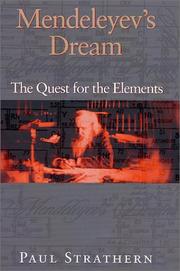
- Bill Gates: "Mendeleyev’s Dream is the best book I’ve ever read on the periodic table. It helps you understand how it all got pieced together and why it’s so helpful." source ↗
Paul Strathern's 2000 book (republished in a 2019 edition by Pegasus Books) traces the 2,000-year history of the quest to identify the fundamental elements of matter, from the Greek philosophers through alchemy to Dmitri Mendeleev's periodic table. Strathern, a British novelist and former philosophy lecturer, tells the story as a sequence of characters and discoveries — Democritus, Aristotle, the alchemists, Boyle, Lavoisier, Dalton, Mendeleev — each pushing the idea of what an element is a step closer to the modern definition.
"Mendeleyev's Dream is the best book I've ever read on the periodic table," Gates writes. "It helps you understand how it all got pieced together and why it's so helpful." A huge periodic table hangs in Gates's office, and the Gates shelf note connects it to a founding insight: 'because we understand atoms we can make chips, therefore software, therefore AI.'
For a founder, the book is a demonstration of how a classification system becomes an engine of discovery. Mendeleev's table was not a summary of what was known — it predicted elements that had not been found, and the gaps told scientists where to dig. A good taxonomy does not just organise existing knowledge; it exposes what is missing. Founders building platforms, marketplaces, or data products that depend on categorising a domain will recognise the pattern: the taxonomy that predicts the gaps is worth more than the taxonomy that merely describes what is already there. Strathern's narrative also carries a subtler lesson: almost every breakthrough in the 2,000-year story came from someone willing to discard a framework that had been trusted for centuries.