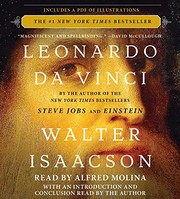
- Bill Gates: "Walter Isaacson’s terrific new biography sheds light on every facet of the artist’s life." source ↗
Walter Isaacson's 2017 biography of Leonardo da Vinci, published by Simon & Schuster, is a 600-page reconstruction of the artist-scientist's life and work based on the 7,200 pages of notebooks he left behind. Isaacson, who previously wrote biographies of Steve Jobs and Einstein, traces Leonardo's childhood outside Florence, his apprenticeship under Verrocchio, his years at the Sforza court in Milan, his anatomical dissections, his engineering designs, and his final years in France. It is a study of how relentless curiosity, organised in notebooks, produced the most varied creative output of any single human.
"Walter Isaacson's terrific new biography sheds light on every facet of the artist's life," Gates writes. The Gates shelf note connects the book directly to a founder context: 'the one person I'd hire to work on any project in any era, because he would have already invented the tools the project needs by lunchtime.' That is the core thesis Isaacson argues: Leonardo's achievement was less about innate genius than about a disciplined practice of recording, questioning, and connecting across domains that were considered separate.
For a founder, the book is a study of how to maintain curiosity as an organisational principle — not as a personality trait but as a method. Leonardo kept notebooks. He drew everything. He asked questions he could not answer. He returned to the same problems (how does blood flow, how does a bird fly) across decades. Isaacson frames him as a 'mistake-tolerant' learner who was more comfortable with unresolved questions than with settled answers. That pattern — sustained cross-domain inquiry, recorded and revisited — is closer to how founders actually operate than any single-discipline expert model of talent.