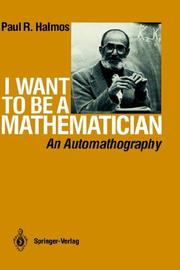
- Paul Graham: "In his (wonderful) autobiography, Paul Halmos says explicitly that for a mathematician, math must come before anything else, including family." source ↗
Paul Halmos's autobiography of a life spent doing mathematics — from his Hungarian immigrant childhood through decades at the University of Chicago, where he worked alongside von Neumann, Gödel, and the other giants of 20th-century mathematics. The book is less a personal memoir than a working mathematician's account of what it actually feels like to prove theorems, teach students, and live inside an abstract world where 'the only thing that matters is the mathematics.' Halmos wrote important papers in ergodic theory, measure theory, and operator theory, but the book's enduring appeal is its honest, unsentimental portrait of a life devoted to an unfashionable calling.
Graham cites Halmos directly in 'Earnestness' as the extreme case of intellectual dedication: 'In his (wonderful) autobiography, Paul Halmos says explicitly that for a mathematician, math must come before anything else, including family.' Graham uses this to illustrate the concept of earnestness — doing something for the right reasons and trying as hard as you can — which he and Jessica Livingston treat as the single most important quality they look for in founders.
For a founder, Halmos's autobiography is a case study in what total commitment to a craft looks like when the rewards are purely intellectual. Halmos had no startup ambitions and made no money from his work; he did it because he couldn't imagine doing anything else. That level of intrinsic motivation is what Graham argues distinguishes the founders who succeed from the ones who don't — and the book makes the contrast visceral. If you're building a startup primarily for the money or the status, Halmos's life is a mirror that shows what genuine, disinterested passion looks like by comparison.