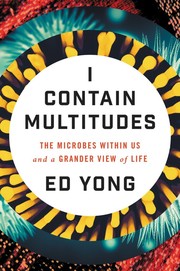
- Bill Gates: "I Contain Multitudes helped me see microorganisms in a whole new light." source ↗
Ed Yong's 2016 book on the microbiome, published by Ecco/HarperCollins, makes the case that every animal is a walking ecosystem of bacteria and other microbes that shape its health, behaviour, and evolution. Yong, a Pulitzer Prize-winning science writer at The Atlantic, takes readers through the discovery that microbes are not invaders to be eradicated but partners that build immune systems, provide camouflage to squid, and allow parasites to cause disease. It won the Royal Society Science Book Prize.
"I Contain Multitudes helped me see microorganisms in a whole new light," Gates writes. The book belongs on a founder's shelf as a model of how to make a paradigm shift concrete: Yong does not argue that microbes matter in the abstract — he shows, animal by animal, experiment by experiment, how the presence or absence of a specific microbe determines whether a host lives or dies.
For founders building in health, diagnostics, therapeutics, food, or agriculture, the book is a primer on the biggest blind spot in modern biology: we have been studying the human body as though it were a single organism. Therapeutically, that means most of the things we call 'germs' are actually essential, and treatments that kill everything indiscriminately (broad-spectrum antibiotics, C-sections that bypass the birth-canal microbiome) may be causing long-term damage we are only beginning to measure. The commercial implication is a shift from 'kill the bug' to 'manage the ecosystem' — a category that barely existed before this decade.