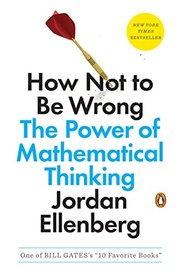
- Bill Gates: "On the surface it’s about math, but it’s really about how much math plays into our daily lives without our even knowing it." source ↗
Jordan Ellenberg's 2014 book on mathematical thinking argues that mathematics is not a distant abstraction but a lens for seeing the world clearly. Published by Penguin Press, it walks through real cases — election forecasting, lottery design, cancer-screening statistics, and the survivorship bias in returning bombers — to show where untrained intuition fails and quantitative reasoning corrects it. Ellenberg is a mathematician and professor at the University of Wisconsin-Madison.
"On the surface it's about math, but it's really about how much math plays into our daily lives without our even knowing it," Gates writes. The specific example he singles out is Abraham Wald and the bullet holes in returning bombers during World War II — armour the engines, not the tails, because the planes hit in the engine never came back. It is survivorship bias as a management lesson: the data you see is the data that survived, and decisions made on visible data alone are decisions made on a cooked sample.
For a founder, the book is a toolkit against the cognitive errors that compound when you move fast. Ellenberg shows that most business intuitions about probability are backwards (the lottery is a tax on innumeracy, not a gamble; rare events are less rare than they feel). The Wald story alone is worth the read: when your dashboard shows only the companies still standing, you systematically misunderstand what killed the ones that are gone. Founders who hire quantitatively literate teams or who build products that depend on statistical claims will find the book a reference they return to.