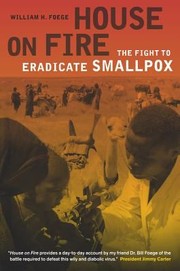
- Bill Gates: "The author, Bill Foege, has been an inspiring advisor to us from the beginning." source ↗
William H. Foege's 2011 account of the smallpox eradication campaign, published by University of California Press. Foege, a physician-epidemiologist who served as CDC director from 1977 to 1983, describes the strategy he devised in 1966 during a Nigerian outbreak — 'surveillance and containment' — which replaced mass vaccination with targeted ring vaccination around reported cases. That strategy was the operational key to the World Health Organization's eradication of smallpox by 1980, the only human disease ever deliberately eliminated.
Gates wrote: "The author, Bill Foege, has been an inspiring advisor to us from the beginning." Foege was a senior advisor to the Gates Foundation, and his smallpox strategy directly influenced the foundation's approach to polio eradication and other disease-elimination programmes.
For a founder, House on Fire is an execution-at-scale case study. The smallpox eradication campaign was a global project with no centralised authority, minimal budget by modern standards, and no reliable data from many of the countries where the disease was endemic. Foege's insight was that mass vaccination was logistically impossible in the poorest regions (the vaccines had a short shelf life and required cold-chain transport), but ring vaccination — vaccinating only the contacts of known cases — was feasible. That insight turned an impossible goal into a solvable logistics problem. Founders who operate in markets with unreliable infrastructure, poor data, and distributed stakeholders should read this for the decision framework, not the public-health content.