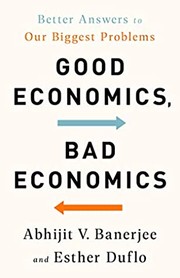
- Bill Gates: "Two economists who are honest about the limits of economics and don’t oversimplify are the husband-and-wife team of Abhijit Banerjee and Esther Duflo." source ↗
Abhijit Banerjee and Esther Duflo's 2019 book, published by PublicAffairs a month after they won the Nobel Prize in Economics. The MIT professors draw on randomised controlled trials and recent empirical research to address immigration, trade, inequality, climate change, and technological unemployment. Each chapter uses experimental evidence to test what actually works rather than what ideological priors predict — an approach that earned the book praise from economists across the political spectrum.
Gates recommended it on his 2020 summer reading list, writing: "Two economists who are honest about the limits of economics and don't oversimplify are the husband-and-wife team of Abhijit Banerjee and Esther Duflo."
For a founder, the book's method matters more than its specific conclusions. Banerjee and Duflo demonstrate a way of reasoning about complex social problems that is directly transferable to product and strategy decisions: state the competing claims clearly, find the existing evidence, test the assumptions you are most uncertain about, and adjust based on what you learn. The immigration chapter is a particularly good case study — they dismantle the claim that immigrants lower wages by walking the reader through how the argument actually works in data, then show which versions hold up and which collapse. Founders who hire globally, sell globally, or build products that interact with regulation will find the method useful even where they disagree with the policy conclusions.