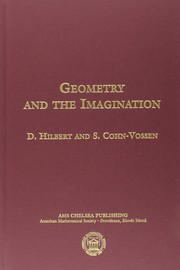
- Paul Graham: "Other highly recommended books: What is Mathematics?, by Courant and Robbins; Geometry and the Imagination by Hilbert and Cohn-Vossen. And for those interested in graphic design, Byrne's Euclid." source ↗
David Hilbert's classic exploration of geometry as a form of visual thinking, co-authored with Stefan Cohn-Vossen. Translated from the 1932 German original 'Anschauliche Geometrie,' the book uses intuitive, visual arguments rather than formal proofs to explore surfaces, polyhedra, knots, lattices, and the geometry of space. It is geometry as the mathematician sees it — a world to be explored with the imagination before the axioms are brought in to nail things down.
Graham recommends it in 'Undergraduation' alongside What is Mathematics? and Byrne's Euclid as one of the books that shows 'what math is really about' — not memorized formulas but a way of thinking that transfers to any hard problem. The unspoken lesson for a founder: the best way to understand a complex system is to develop an intuitive, visual feel for it before getting lost in formalism.
For a founder, geometry is a domain where first-principles thinking is inescapable — you cannot fake understanding of a geometric relationship the way you can fake understanding of a business metric. Hilbert's method of 'anschauliche' (intuitive, concrete) thinking before formalization is a model for approaching any messy, ill-defined problem: build a mental picture first, then layer structure on top of it. The book's emphasis on imagination over computation reinforces Graham's broader argument that the most powerful thinking tools are not the most formulaic ones.