- Andrew Carnegie: "Light came as in a flood and all was clear... 'All is well since all grows better' became my motto, my true source of comfort." source ↗
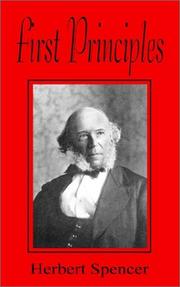
Published in 1862, First Principles is the opening volume of Herbert Spencer's multi-decade 'Synthetic Philosophy' project, an attempt to unify all knowledge — physics, biology, psychology, sociology, ethics — under a single evolutionary framework. Spencer argues that everything in the universe, from stars to societies, moves from an incoherent, homogeneous state toward a coherent, differentiated one, a process he calls evolution and grounds in the more basic law he terms the 'persistence of force.' The book predates and heavily influenced the popular use of the phrase 'survival of the fittest,' which Spencer coined before Darwin adopted it.
First Principles is not a business book, but it is the ur-text for the idea of reasoning from fundamentals rather than from analogy — the habit of stripping a problem down to the basic forces at work and rebuilding an explanation from there, rather than accepting inherited categories and conventions. This is the same intellectual move founders invoke when they talk about 'first principles thinking': don't reason by comparison to what already exists, reason from the underlying physics (or economics, or psychology) of the situation.
Spencer's broader project — trying to find one small set of laws that explains an enormous range of phenomena, from the cooling of nebulae to the structure of governments — is itself a model for how founders try to find the few root causes that explain a business's behavior, rather than treating every symptom as its own problem. His concept of development as a move from simple, undifferentiated systems to complex, specialized ones also maps onto how organizations evolve: a founder-generalist doing every job gradually gives way to specialized teams and functions as a company scales, mirroring the exact pattern Spencer describes in biological and social systems.
The book is dense and its cosmology is dated by modern science, but its core discipline — refuse to take any claim as given until you have traced it back to something you can verify yourself — is the same discipline prized by builders who distrust convention and want to understand a market or a technology from the ground up.