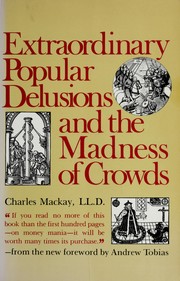
- John Bogle: "This classic still influences writers and economists today, and provides a cautionary tale for those who might follow the crowd as the next bubble — there undoubtedly will be one — and inevitably deflates." source ↗
Extraordinary Popular Delusions and the Madness of Crowds is Charles Mackay's 1841 survey of crowd psychology, documenting historical manias from the Mississippi Scheme and the South Sea Bubble to the tulipomania of 1637. Mackay's central observation is that otherwise rational people reliably participate in collective self-deception when the crowd is moving in one direction. The book is the founding text of behavioral finance and is widely cited by investors from Buffett to Bogle.
Bogle placed this on his must-read list as a cautionary tale for those who follow the crowd into the next bubble. Senra uses Mackay to make the argument that the startup world is as prone to manias as any financial market — the same psychology that drove the South Sea Bubble drives every subsequent hype cycle in technology.
For founders, Mackay's most important insight is that manias are not caused by irrational people but by rational people acting in a system that rewards short-term participation over long-term independence. The venture capital cycle — follow the hot sector, raise the next fund, repeat — is the Mackay pattern restaged in startup form. Senra's take is that the best founders are the ones who can isolate themselves from the crowd's emotional temperature, and that Mackay is the historical proof that this ability is rare precisely because it is unnatural.
The book is on this shelf because Bogle saw the mutual fund industry's fee inflation and product proliferation as a delusion as obviously unsustainable as tulip bulbs, and because every founder who has ridden a hype cycle upward and survived the crash recognizes the pattern. Mackay's value is prophylactic: read it early enough and you may avoid being the most recent example.