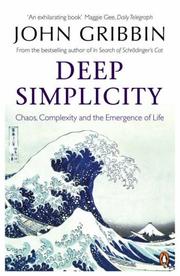
- Charlie Munger Gribbin appears twice on Munger’s list. This one is about how complicated behaviour falls out of simple rules — the physics counterpart to his complaint that economists ignore second- and higher-order effects. source ↗
John Gribbin's accessible account of chaos and complexity theory, explaining how simple rules at the microscopic level generate unpredictable, emergent behavior at the macroscopic level — from weather to evolution to ecosystems. The book shows why the most complex phenomena often arise from the simplest underlying laws.
Munger placed Gribbin on his recommended list because Deep Simplicity mirrors his core complaint about economics — that it ignores second- and higher-order effects. The book shows founders that complex outcomes (company culture, market dynamics, product adoption) emerge from a small number of interacting rules, not from top-down planning. This is the physics counterpart to Munger's Lollapalooza effect: when several forces push in the same direction, the result is nonlinear and often surprising. The model is directly useful for founders puzzling over why their carefully designed incentive structure produced exactly the wrong behavior.